Article
Rediscovering African Design Confidence
Mar 18, 2026
Article
Mar 18, 2026
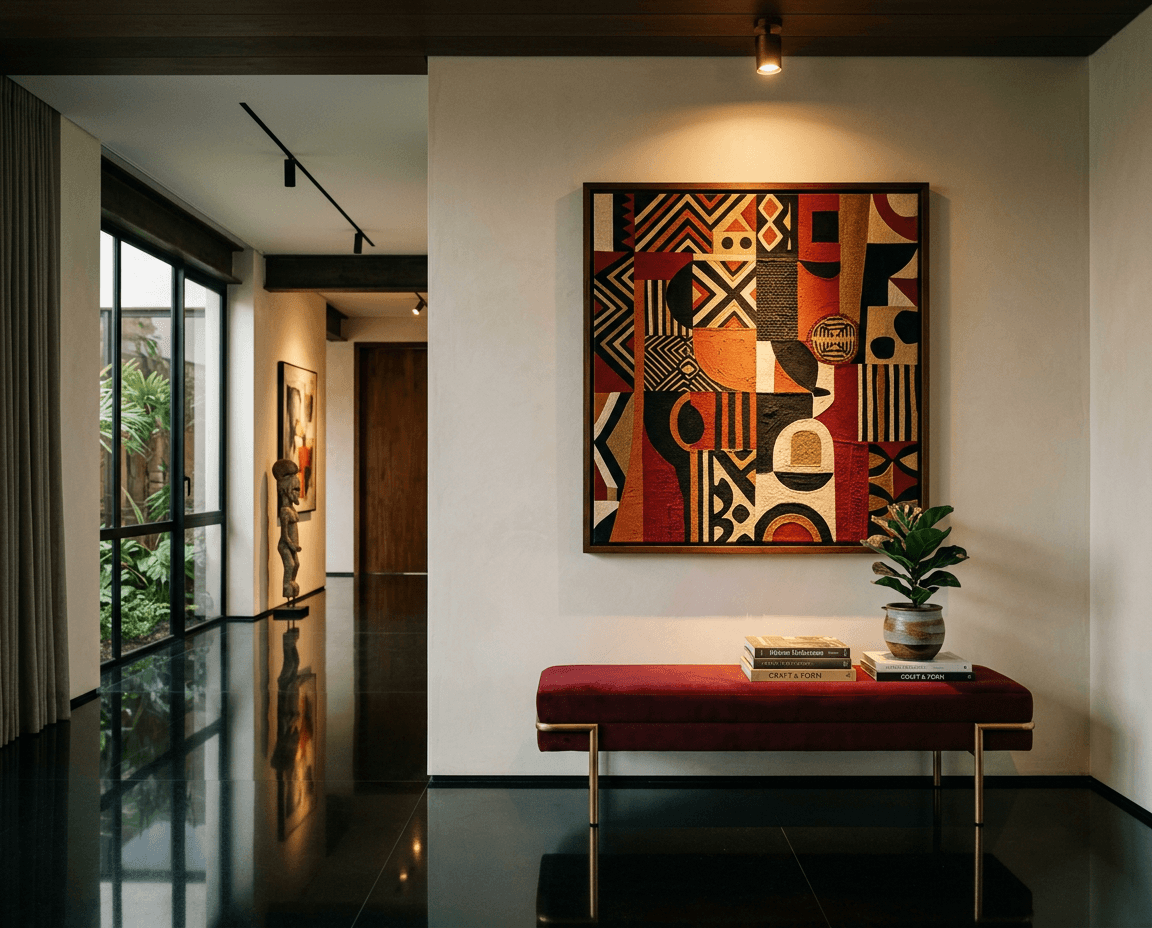
Design is never created in isolation from history.
The spaces people build, the objects they value, and the materials they choose are all shaped by cultural memory. Architecture and interior design therefore carry traces of the social and historical forces that have shaped societies over time.
For Africa, one of the most significant of these forces was colonisation.
It would be impossible to discuss the evolution of African design without acknowledging this chapter of history. Colonisation did not only alter political and economic systems; it also affected how many African societies began to perceive their own cultural identity.
Before colonisation, African cultures possessed deeply developed design traditions. Architecture, craft, textiles, and ceremonial objects reflected sophisticated systems of symbolism, material knowledge, and spatial thinking.
Yet during the colonial period, many of these traditions were gradually dismissed or undervalued. European design ideals were often positioned as the standard of refinement, while local cultural expressions were sometimes regarded as primitive or informal.
Over time, this created a subtle shift in perception.
Many African societies began to view European aesthetics as aspirational while distancing themselves from elements of their own cultural heritage. Materials, forms, and craft traditions that once held deep meaning were sometimes set aside in favour of imported styles.
This shift was not always deliberate; it was often the result of changing social systems and global influence.
European design traditions have undeniably shaped global architecture and interior design. Classical proportion, Renaissance ornamentation, and modern European movements such as Bauhaus and Scandinavian minimalism have all contributed enormously to contemporary design thinking.
For many African designers, these influences were part of early exposure to design education and professional practice.
The softness of upholstered furniture, the structure of classical architectural proportion, and the refinement of European craftsmanship introduced new design languages that many designers found compelling.
Yet the story does not end there.
Across Africa today, designers are beginning to revisit their cultural foundations with renewed interest and confidence. This return is not about rejecting international influences. Rather, it is about rediscovering the intelligence embedded within African design traditions and allowing them to coexist with global design languages.
When we look again at African craft traditions, architecture, and material culture, we find remarkable sophistication: geometric logic, symbolic pattern, material innovation, and spatial awareness.
These elements were never absent. They were simply waiting to be seen again with fresh perspective.
One of the responsibilities of contemporary designers is to participate in telling the stories of the cultures from which they come.
If those stories are not told by those who understand them, they risk being interpreted—or misunderstood—by others.
This does not mean design must become nostalgic or confined to tradition. On the contrary, the most compelling work often emerges when heritage is interpreted through modern design thinking.
African designers today are not recreating the past. They are translating cultural memory into contemporary environments.
Through this process, design becomes both creative expression and cultural narrative.
Ultimately, design has always been shaped by cultural exchange.
African design has influenced global aesthetics for centuries, just as European and Asian traditions have shaped architecture and interiors around the world. Ideas move across continents, materials travel across borders, and designers continuously learn from one another.
Rather than existing in competition, these traditions exist in dialogue.
There is beauty in European design, in Asian craftsmanship, and in African material culture. Each tradition brings its own philosophy, history, and visual language.
When these influences come together thoughtfully, design becomes richer and more layered.
Today, African design is entering a new chapter—one defined by renewed cultural confidence.
Designers across the continent are increasingly comfortable embracing both their heritage and their global influences. They no longer feel compelled to choose between the two.
Instead, African design is becoming something more powerful: a conversation between cultures, histories, and contemporary ideas.
And through that conversation, a new vision of luxury design is emerging—one that is deeply rooted, yet unmistakably global.