Article
The Rise of Modern African Luxury Design
Mar 17, 2026
Article
Mar 17, 2026
For many years, African design existed on the margins of the global design conversation.The continent was often referenced as a source of inspiration, its textiles, craft traditions,and landscapes frequently appearing in international collections, yet African designers themselves were rarely positioned at the centre of the narrative.
That dynamic is gradually changing.
Across the continent, a new generation of architects, artists, and interior designers is beginning to articulate a distinctly African approach to luxury design. Rather than borrowing from established European traditions, many studios are returning to the cultural foundations of the continent itself, reinterpreting heritage, materials, and architectural thinking for a contemporary global audience.
In many ways, this moment represents a shift from Africa as inspiration to Africa as leadership within the global design landscape.
At King Farai, our work forms part of this evolving movement.
One of the most powerful aspects of African design lies in its deep connection to culture and craftsmanship. Across Southern Africa, everyday objects have long carried remarkable design intelligence. Sculptural forms, geometric rhythm, and careful material use appear even in objects that were never originally created as “design pieces” in the contemporary sense.
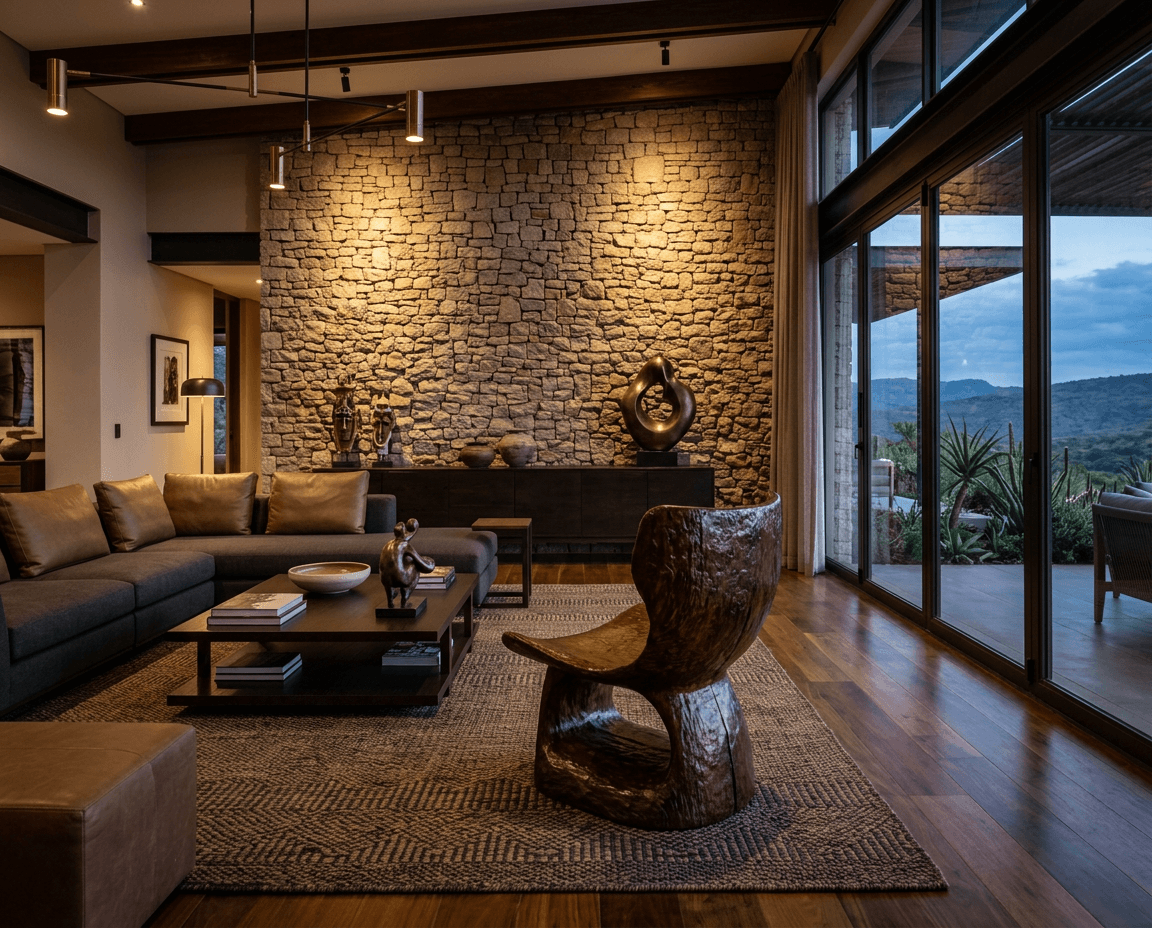
The traditional Shona carved wooden footstool is one such object. At first glance, it appears simple: a low wooden stool carved from a single piece of timber. Yet when one begins to study its proportions and form more carefully, a remarkable sophistication emerges. The curves are balanced and deliberate. The silhouette carries both strength and elegance. The object feels sculptural without being ornamental.
For us, objects like this become important points of reference. They remind us that design intelligence has long existed within African cultural traditions. When translated into contemporary interiors, these forms can inspire furniture silhouettes, sculptural seating pieces, or architectural gestures that echo the same sense of balance and quiet authority.
In this way, heritage becomes not a historical reference, but an active source of design thinking.
Architecture offers another powerful example of African design intelligence.
Few structures illustrate this more profoundly than the Great Zimbabwe ruins, one of the most significant historical architectural sites in Southern Africa.
Constructed centuries ago, the stone walls of Great Zimbabwe were built entirely from carefully cut granite blocks, stacked without mortar. The precision of the stonework, the curvature of the walls, and the scale of the construction reveal an extraordinary level of architectural mastery.
Standing among these ruins, one cannot help but feel the presence of an empire that understood both engineering and symbolism. The stone walls carry a quiet monumentality, strong, grounded, and enduring.
For designers today, Great Zimbabwe offers a powerful reminder of Africa’s architectural legacy.
In many contemporary interiors, stone surfaces can echo this same sense of permanence and strength. Carefully cut marble, travertine cladding, or textured stone walls often become architectural anchors within our projects, subtly referencing this historical relationship between material and monumentality.
The luxury of hand-cut stone is not merely aesthetic. It carries a sense of history, craft, and permanence.
As African design gains greater global recognition, the materials of the continent are also beginning to influence contemporary luxury interiors.
Stone, timber, clay-based plasters, and woven textiles all bring a tactile richness that contrasts with the synthetic materials often associated with modern construction. These materials carry natural variation and depth, creating interiors that feel alive rather than manufactured.
When combined with refined craftsmanship and contemporary architectural thinking, these materials create spaces that feel both modern and timeless.
At King Farai, we often approach material selection with this balance in mind, allowing African material sensibilities to guide the atmosphere of a space while integrating global manufacturing expertise to achieve precision and refinement.
Across Africa today, designers are beginning to articulate a new visual identity for the continent. Studios in cities such as Johannesburg, Lagos, Accra, Nairobi, and Cape Town are redefining luxury design by blending contemporary architecture with cultural memory and natural materials.
Rather than imitating established Western design styles, many designers are embracing African spatial sensibilities, spaces that feel grounded, atmospheric, and connected to landscape and heritage.
This shift represents something larger than a stylistic trend. It signals a growing confidence within African design culture.
The continent is beginning to speak in its own design voice.
At King Farai, our work continues to evolve within this broader movement.
Our design journey has always been shaped by a combination of influences: the cultural rhythms of Shona tradition, the architectural legacy of places like Great Zimbabwe, and the global craftsmanship that allows contemporary design ideas to be realised at the highest level.
Each project becomes an opportunity to explore how these influences can coexist within modern interiors.
The carved stool becomes a sculptural reference. Hand-cut stone becomes architectural memory. African geometry becomes spatial order.
Through this process, the past does not remain behind us. It becomes part of the language through which we design the future.
The global design world is entering a period of profound cultural exchange. Designers are increasingly looking beyond traditional centres of influence to discover new ideas, materials, and design philosophies.
In this environment, Africa has much to offer.
The continent’s design traditions emphasise material authenticity, symbolic form, and a deep connection between architecture and landscape. These values resonate strongly with contemporary ideas about sustainability, craft, and meaningful living.
As African designers continue to reinterpret these traditions for modern contexts, a new design movement is emerging, one that is both deeply rooted and unmistakably global.
And in many ways, this movement is only just beginning.